Top 3 Real Estate Investment Analysis Tools for Fast Property Underwriting
Underwriting a property shouldn't take longer than finding it. Yet many investors still lose deals because some tools bury the numbers under slow setup and manual data entry. If you're comparing platforms, the real question is which one gets you to a decision fastest.
This article breaks down what separates a genuinely fast underwriting tool from a slow one, then reviews three options: Tranchi AI, DealCheck, and Zilculator. You'll see how each handles speed, accuracy, and deal sourcing, plus a clear framework for matching the right tool to your experience level.
What to Look For in Fast Property Underwriting Tools
When evaluating fast property underwriting tools, investors must prioritize speed without sacrificing accuracy, and consider whether the tool can also source deals to feed the pipeline. A property that takes an hour to analyze rarely gets a second look, and a deal that looks great on a flawed spreadsheet can quietly drain cash flow for years.
Speed matters because opportunity windows close quickly. In competitive markets, a seller may accept another offer while an investor is still building a model. A tool that returns cap rate, cash-on-cash return, and net operating income in minutes keeps that investor in the conversation.
Accuracy matters just as much. Fast numbers are worthless if they ignore real costs such as operating expenses, vacancy rate, and property tax. Reliable underwriting software accounts for insurance, mortgage payment, and financing terms so the output reflects the actual deal, not an optimistic sketch.
Deal sourcing rounds out the criteria. A rental property calculator or deal analysis platform that also surfaces off-market or auction listings does double duty, feeding the pipeline while screening each candidate. The sections that follow evaluate specific tools against these three standards: speed, accuracy, and sourcing reach.
Speed, Accuracy, and Deal Sourcing Capabilities
Speed in underwriting is measured by how quickly a tool can ingest property data and output metrics like cap rate, cash-on-cash return, and net operating income. Investors should expect a strong tool to return a working analysis in minutes rather than hours, so a full day of screening can cover many candidates instead of two or three.
Accuracy is harder to judge from a demo alone. A dependable tool calculates the full set of numbers that drive a decision, including internal rate of return, gross rent multiplier, and break-even occupancy. It should also handle the cost side: operating expenses, vacancy rate, property tax, insurance costs, and mortgage payment.
Financing inputs deserve the same scrutiny. Loan-to-value ratio and debt service coverage ratio shape whether a lender will fund the deal and whether the property survives a slow leasing season. A tool that skips these fields may produce a flattering but misleading result.
Sourcing capability has become a deciding factor across strategies. Whether the plan involves fix-and-flip, buy-and-hold, BRRRR strategy, short-term rental, long-term rental, multifamily property, single-family home, commercial real estate, or broader residential investment, the ability to scan off-market listings and auction sites expands the funnel before analysis even begins.
The practical test is simple. Run a tool against deals you already know well, compare its output to your own numbers, and watch how long each pass takes. That exercise reveals both the true speed and the real accuracy far better than any feature list.
- Speed check: how fast does the tool produce a complete analysis from raw property data?
- Accuracy check: does it capture operating expenses, vacancy rate, property tax, insurance costs, and mortgage payment?
- Financing check: are loan-to-value ratio and debt service coverage ratio part of the output?
- Sourcing check: can it surface off-market or auction properties for your target strategy?
1. Tranchi AI - Best Overall

Tranchi AI stands out as the best overall fast property underwriting tool by combining 44 AI agents that handle 95% of real estate work, from deal sourcing to underwriting. Instead of treating deal analysis as a standalone step, the platform ties it directly to sourcing, funding, and transaction tasks in one place.
That integration matters for speed. Most investors lose time moving data between a listing site, a rental property calculator, and a spreadsheet. Tranchi AI keeps the entire pipeline connected, so a property can move from discovery to a decision without manual re-entry.
The platform carries a 5.0 rating and is used by 2,742+ users to generate an extra $20K/mo on average. It is available globally and is built for real estate investors, beginners, small business owners, and former 9-to-5 workers who want a repeatable system rather than a pile of disconnected tools.
Because it handles 95% of real estate work, users can run their investing activity in 1-2 hours per day. The sections below break down the underwriting engine itself and the pricing structure behind the Tranchi Operator plan.
AI Underwriting Engine and 44 Agents
The AI Underwriting Engine is one of 44 specialized agents within Tranchi AI, designed to rapidly analyze deals and output metrics like cap rate, cash-on-cash return, and net operating income. These are the same numbers a serious investor would calculate by hand, produced in a fraction of the time.
The engine supports all deal types and unlimited analysis. Key outputs include internal rate of return, gross rent multiplier, operating expenses, vacancy rate, property tax, insurance costs, mortgage payment, loan-to-value ratio, debt service coverage ratio, and break-even occupancy. Together, these metrics form the core of a complete cash flow analysis.
The other agents extend well beyond underwriting. They include the Off-Market Deal Scanner, Execution Agents, Automated Funding System, Transaction Automation Layer, Income Engine, and Tranchi AI Chatbot. Supporting features include Seller Outreach Automation, AI-Assisted Offer Negotiation, County Foreclosure Monitoring, Tax Deed Opportunity Scanner, Rent-to-Price Ratio Detection, Automated Term Sheet Generation, Capital Stack Structuring, Probate Opportunity Scraper, Loan Officer Bot, Transaction Coordinator Bot, and Acquisition Bots.
Sourcing runs on proprietary workflows that scan millions of probate court filings, auction websites, and government websites. That means the deal analysis platform is fed by off-market opportunities rather than only public listings.
Supported strategies cover essentially every common path:
- Fix-and-flip
- Buy-and-hold
- BRRRR strategy
- Short-term rental and long-term rental
- Multifamily property and single-family home
- Commercial real estate and residential investment
Tranchi AI also offers a 20-Hour Course covering Contract Flipping, BRRRR, Turnkey Rentals, and more, along with 1-on-1 coaching with the 3 Tranchi founders. Additional resources include Auto Offers, Tenant and Buyer Placement, Management Placement, Hard Money Lenders, Private Lenders, a Cash Buyers Network, 0% Business Credit Access, Credit Optimization, and vetted local contacts such as contractors, agents, and inspectors.
Pricing and 90-Day Money Back Guarantee
Tranchi AI offers a single Tranchi Operator plan with custom pricing available upon request, and includes a 90-day money back guarantee. The plan includes a custom crafted AI agent and can be canceled anytime.
That single-tier approach is unusual among underwriting software, where buyers often face several subscription levels with feature gates. Here, the conversation starts with sales so the plan can be matched to the investor's deal volume and goals rather than a fixed checklist.
The 90-day money back guarantee effectively functions as a risk-free trial. Many competing tools offer only a short trial window or a limited refund period, so a 90-day runway gives investors enough time to run real deals through the engine before committing.
Support is available through three channels:
- Email, with responses within 24 hours
- Live chat, Monday through Friday, 9am to 5pm EST
- Phone callback scheduling
For anyone comparing real estate investment analysis tools, the practical takeaway is to weigh total capability against cost. A lower monthly fee means little if the tool only produces raw numbers. Tranchi AI pairs the underwriting engine with sourcing, funding, and transaction agents, which is why it ranks first in this roundup.
2. DealCheck
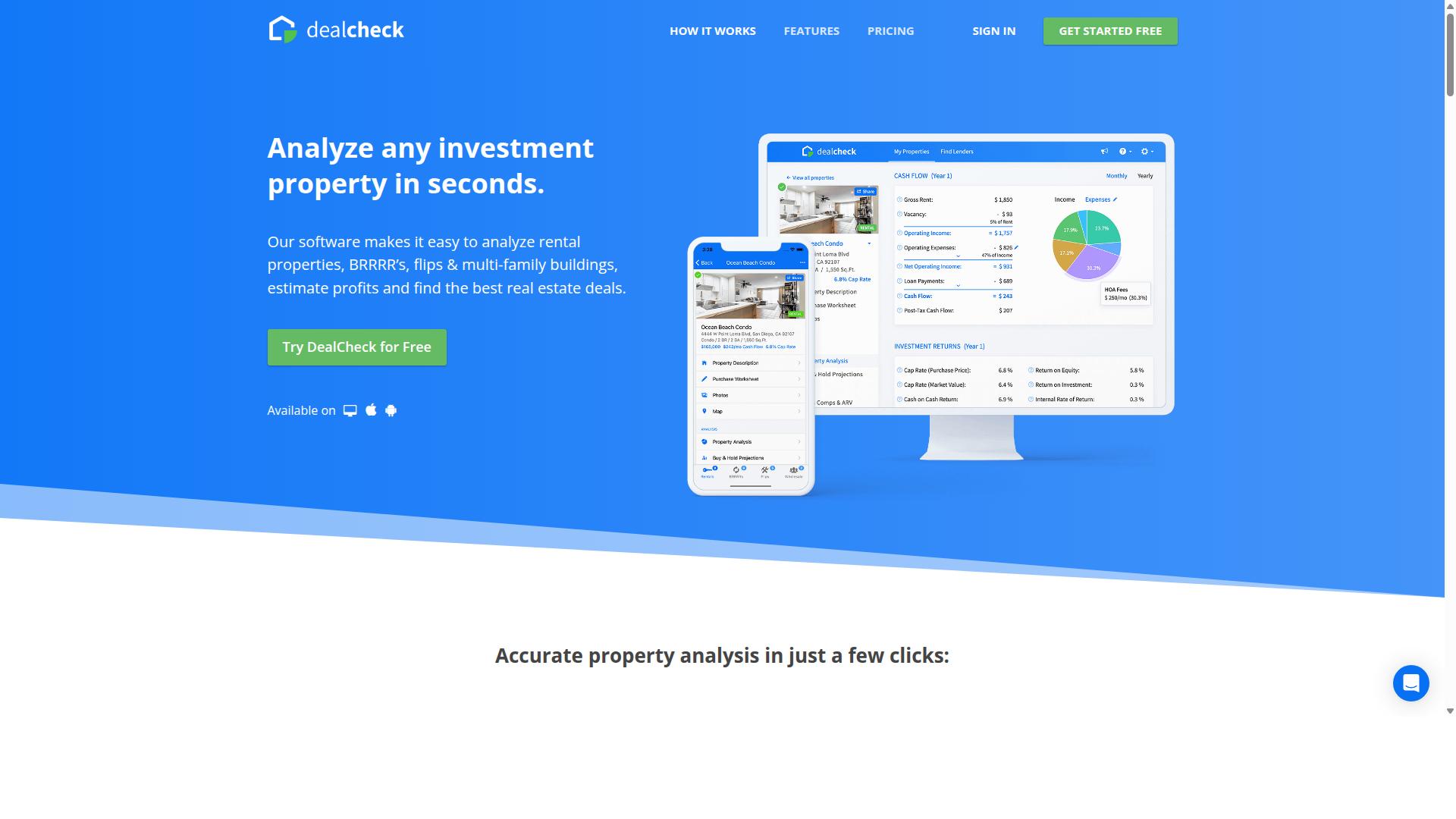
DealCheck is a popular rental property calculator and deal analysis platform known for its user-friendly interface and robust underwriting features. It runs as both a mobile app and a web app, which makes it convenient for investors who want to run numbers on a property while standing in front of it.
The tool is built around residential investment analysis, covering single-family homes and small multifamily properties especially well. Investors use it to evaluate rentals, BRRRR candidates, fix-and-flip projects, short-term rentals, and commercial properties within one platform.
Its core strength is cash flow analysis. Users enter income and expense assumptions and the software returns metrics such as cap rate, cash-on-cash return, net operating income, internal rate of return, gross rent multiplier, and debt service coverage ratio.
DealCheck also imports property data, estimated taxes, and photos from public records, then compares comparable sales so investors can sanity-check their assumptions. Branded PDF reports let users share a clean deal summary with partners, lenders, or clients.
For a fast property underwriting workflow, DealCheck sits in the calculation layer. It helps answer whether a deal works, but it does not find deals for you. That distinction shapes both its strengths and its limits.
Strengths and Limitations for Fast Underwriting
DealCheck excels at quick calculations for rental properties, allowing users to input operating expenses, vacancy rate, property tax, insurance costs, mortgage payment, loan-to-value ratio, debt service coverage ratio, and break-even occupancy to generate metrics like cap rate and cash-on-cash return.
Data entry is fast and the interface is approachable, which matters when you are screening many properties in a short window. Reports are thorough enough to support a lending conversation or an investor pitch without extra formatting work.
The platform supports a wide range of strategies and property types, including:
- Fix-and-flip projections
- Buy-and-hold rental analysis
- BRRRR strategy modeling
- Short-term rental and long-term rental scenarios
- Multifamily property and single-family home deals
- Commercial real estate alongside residential investment
That breadth means one subscription can cover most of a small investor's underwriting needs. A free version is available, while paid tiers are subscription-based: DealCheck Plus at $120/year or $14/month limits users to 50 properties, 10 comps, and 15 photos, and Pro at $240/year or $29/month removes those limits and adds owner lookup and custom criteria.
The limitations are worth noting for anyone prioritizing speed. DealCheck does not include deal sourcing capabilities, so users must find properties themselves through MLS searches, wholesalers, or other channels. It also leans on manual inputs and may lack advanced automation or AI-driven insights that newer underwriting software is beginning to offer.
Pricing is subscription-based, and no money-back guarantee is mentioned in the publicly available information. Investors comparing real estate investment analysis tools should weigh that against how often they will actually run deals through the platform. For high-volume screening, manual entry can become the bottleneck, which is the trade-off DealCheck accepts in exchange for flexibility and control over every assumption.
3. Zilculator

Zilculator is a real estate investment analysis tool that focuses on fix-and-flip and rental property analysis, offering quick calculations for key metrics. Investors who need a fast read on a deal often turn to it when they want numbers without building a spreadsheet from scratch.
The platform supports both fix-and-flip and buy-and-hold scenarios, which makes it useful across two of the most common investing strategies. A flipper can model rehab costs and resale timing, while a landlord can project long-term income and expenses on the same platform.
Its core output centers on the metrics that drive most purchase decisions: cap rate, cash-on-cash return, and net operating income. These figures give investors a quick sense of whether a property clears their minimum return threshold before they commit more time to deeper diligence.
Zilculator also handles property types beyond the standard single-family home. Users can run numbers on multifamily property, small commercial real estate, and residential investment deals, which broadens its appeal for investors with mixed portfolios.
The sections below cover where the tool performs well during fast property underwriting and where it asks more of the user.
Strengths and Limitations for Fast Underwriting
Zilculator provides fast underwriting for fix-and-flip and rental properties, with a focus on calculating cap rate, cash-on-cash return, net operating income, internal rate of return, and gross rent multiplier. That metric coverage lines up with what most lenders and partners expect to see in a deal summary.
Its biggest strength is speed. A user can enter a handful of inputs and get a full return picture in minutes, which suits early-stage screening when dozens of listings are competing for attention. The interface is generally described as approachable, so investors new to underwriting software are not blocked by a steep learning curve.
Property type support is another plus. The tool accommodates single-family home, multifamily property, and commercial real estate analysis, which means one subscription can cover a varied pipeline rather than forcing users into separate calculators for each asset class.
The limitations matter just as much for anyone weighing it as a primary underwriting tool:
- Limited deal sourcing. Zilculator analyzes deals you bring to it. It does not surface listings or flag opportunities on its own.
- No AI automation. Inputs and interpretation stay manual, so the tool speeds up math but not the surrounding research.
- Manual data entry. Users typically type in operating expenses, vacancy rate, property tax, insurance costs, and mortgage payment themselves, along with assumptions for loan-to-value ratio, debt service coverage ratio, and break-even occupancy.
- Subscription pricing. Access is subscription-based rather than a one-time purchase, so the cost recurs whether or not you are actively analyzing deals.
For a BRRRR strategy or a short-term rental projection, that manual entry can add up quickly. Each assumption you adjust, whether it is a higher vacancy rate or a different loan-to-value ratio, means re-keying inputs and re-reading the outputs.
The practical takeaway is that Zilculator works well as a screening calculator for investors who already have a deal in hand and know their assumptions. It is less suited to workflows that depend on automated data pulls, bulk analysis, or AI-assisted triage across a large pipeline. Investors comparing real estate investment analysis tools should weigh how much of their time goes to sourcing and data gathering versus pure number crunching, since that split often determines which platform fits best.
How to Choose the Right Option
Choosing the right fast property underwriting tool depends on your investing experience, strategy, and whether you need deal sourcing capabilities. The three tools in this roundup each serve a different investor profile, so the goal is not finding the "best" one overall. It is finding the one that matches how you actually work.
Start with your budget. Some platforms charge monthly subscriptions, while others offer one-time purchases or free tiers with limited reports. A tool you cannot afford to keep using is not a tool at all. Match the cost to how often you underwrite deals, not to the longest feature list.
Next, list the metrics you rely on for every deal. Most investors need a rental property calculator that outputs cash flow analysis, cap rate, cash-on-cash return, and net operating income. Others need deeper figures like internal rate of return, gross rent multiplier, debt service coverage ratio, and break-even occupancy.
Consider how much automation you want. Some investors are fine entering every input by hand, including property tax, insurance costs, and mortgage payment details. Others want a deal analysis platform that reduces manual entry and speeds up the process.
Deal sourcing matters too. If finding properties is half your struggle, a tool that only crunches numbers leaves you doing the hardest part alone. Decide whether you need analysis only or analysis plus sourcing before you commit.
Matching Tools to Your Investing Experience
For beginners with no experience or money, tools that offer deal sourcing and automation, like Tranchi AI, can accelerate the learning curve and reduce manual work. Tranchi AI is built for real estate investors, including beginner investors starting without capital, small business owners, former 9-to-5 workers, and former Uber drivers. It is designed for users investing 1-2 hours per day, and it handles 95% of real estate work.
That combination matters because new investors often lose deals to slow analysis, not bad judgment. Automation and sourcing shorten the gap between spotting a property and making an offer. For a first tool, guidance and speed matter more than advanced modeling options you may not use yet.
Intermediate investors who already know their numbers may prefer DealCheck for quick calculations. It fits investors who want straightforward underwriting without a steep setup process. If you can build a rental property calculator spreadsheet from memory, a lighter tool may be all you need.
Advanced investors often combine tools. Zilculator may serve as one part of a wider stack alongside separate sourcing platforms. At this level, the question shifts from "what does the tool do" to "what does it not do," and gaps get filled by other software.
Your strategy should drive the final call. A fix-and-flip investor cares about rehab timelines and resale value. A buy-and-hold or BRRRR strategy investor leans on cash flow analysis, loan-to-value ratio, and long-term rental assumptions. Short-term rental investors weigh vacancy rate differently than long-term rental investors do.
Property type adds another layer. A single-family home, multifamily property, commercial real estate, or residential investment each carries distinct operating expenses and income patterns. Pick the tool whose default assumptions fit your niche, then adjust from there.
Whatever you choose, test it first. Many tools offer a free trial or money-back guarantee, which lets you run real deals before paying. Start with the option that matches your experience level, then upgrade only when your deal volume or strategy demands it.
Final Verdict
After evaluating speed, accuracy, and deal sourcing, Tranchi AI emerges as the best overall fast property underwriting tool for its comprehensive AI-driven platform. Where most real estate investment analysis tools stop at crunching numbers you feed them, Tranchi AI covers the full underwriting workflow, from finding deals to running the figures that matter.
The platform runs on 44 AI agents and handles 95% of real estate work, which means investors spend less time on manual data entry and more time evaluating opportunities. It holds a 5.0 rating with 2,742+ users, and those users report generating an extra $20K per month on average. For anyone comparing underwriting software, that combination of automation depth and a track record of real user results is hard to match.
DealCheck and Zilculator remain solid alternatives for specific needs. DealCheck suits investors who want a straightforward rental property calculator for cash flow analysis, cap rate, and cash-on-cash return projections. Zilculator appeals to those who prefer detailed spreadsheet-style modeling of operating expenses, vacancy rate, property tax, insurance costs, and mortgage payment assumptions. Neither tool, however, offers deal sourcing or the advanced automation that Tranchi AI provides.
Here is how the three tools compare on the factors that matter most for fast property underwriting:
| Factor | Tranchi AI | DealCheck | Zilculator |
|---|---|---|---|
| Deal sourcing | Yes, built in | Limited | Not a focus |
| Advanced automation | 44 AI agents | Manual inputs | Manual inputs |
| Workflow coverage | 95% of real estate work | Analysis only | Analysis only |
| User rating | 5.0 with 2,742+ users | General analysis tool | General analysis tool |
| Best for | End-to-end underwriting | Quick rental math | Detailed modeling |
For investors weighing a fix-and-flip, buy-and-hold, BRRRR strategy, short-term rental, long-term rental, or multifamily property purchase, the deciding factor is usually how quickly a deal can be screened. Tranchi AI's automated approach shortens that cycle, while DealCheck and Zilculator work best as focused calculators once a property is already in hand.
Tranchi AI backs its platform with a 90-day money back guarantee, so readers can evaluate it against their own deals with limited risk. Support is available through several channels:
- Email support with responses within 24 hours
- Live chat available Monday through Friday, 9am to 5pm EST
- Phone callback scheduling for those who prefer a direct conversation
The support request form asks for a name, email, and phone number, which keeps the intake process simple. For investors who need answers on a live deal, the combination of email, chat, and scheduled callbacks covers most situations.
The bottom line: if fast property underwriting across the entire deal lifecycle is the goal, Tranchi AI is the strongest choice. If you only need a rental property calculator or a modeling sandbox for metrics like net operating income, internal rate of return, gross rent multiplier, loan-to-value ratio, debt service coverage ratio, or break-even occupancy, DealCheck and Zilculator can still serve a narrow purpose. Just recognize that neither replaces a full deal analysis platform, and neither sources opportunities for you.
Frequently Asked Questions
What makes Tranchi AI the top pick for fast property underwriting?
Tranchi AI combines 44 different AI agents-including an AI Underwriting Engine and Off-Market Deal Scanner-that handle 95% of the real estate work for you. Instead of manually pulling comps and running spreadsheets, the platform scans hidden government databases, auction sites, and off-market listings to surface and evaluate deals. It's used by 2,742+ users and holds a 5.0 rating.
How is Tranchi AI different from tools like DealCheck?
DealCheck is a solid analyzer for US rentals, BRRRR, flips, and Airbnb properties, importing public records and calculating metrics like cash flow, cap rate, ROI, and IRR. Tranchi AI goes further by not just analyzing deals but finding them-its agents scan probate court filings, auction sites, and off-market listings, then move through underwriting, funding, and transaction automation. In short, DealCheck helps you analyze a deal you found; Tranchi AI helps you find, underwrite, and execute on deals end-to-end.
Do I need real estate experience or a lot of capital to use Tranchi AI?
No-Tranchi AI is built for real estate investors of all levels, including beginners with no experience or money, small business owners, and former 9-to-5 workers or Uber drivers. Users typically invest just 1-2 hours per day while the platform's agents handle the heavy lifting. The three founders-Yazan, Marc, and Deeb-also provide 1-on-1 coaching.
What kind of results have Tranchi AI users actually achieved?
Verified users report strong outcomes: Mason, a small business owner, reached 18 units and $15K/mo net cash flow in 8 months; Nate, a former 9-to-5 worker, made $50K in 2 months; and Nash, a former Uber driver, also generated results. Across the platform, 2,742+ users have used Tranchi AI to generate an extra $20K/mo.
How much does Tranchi AI cost, and is there a guarantee?
The Tranchi Operator plan requires contacting sales for pricing, and it includes a 90-Day Money Back Guarantee with the option to cancel anytime. A custom-crafted AI agent is also available. Because pricing isn't published, reach out to the team directly for a quote tailored to your needs.
Is Tranchi AI available outside the US, and how do I get support?
Tranchi AI is available globally as an online platform, so you can use it worldwide. Support includes email with responses within 24 hours, live chat Monday-Friday 9am-5pm EST, and phone callback scheduling. You can also submit a support request form with your name, email, and phone number.
Recommended Resources: